JANUARY 2026 – MALAWI | MOROCCO | UAE
MINIMUM WAGE AND TAX CHANGES FOR 2026
It is important that employers note the following:
MALAWI
Tax changes for 2026
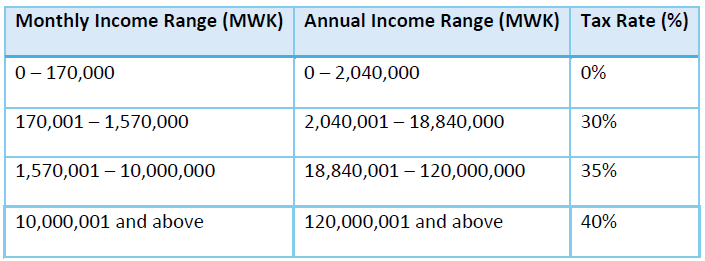
As part of the 2025/26 Mid-Year Budget Review, the Government of Malawi has introduced amendments to the Pay As You Earn (PAYE) tax structure aimed at increasing tax equity and improving revenue collection. Effective from 1 January 2026, these changes include a higher zero-rated threshold and revised tax brackets.
The PAYE changes were signed into law and published on 30 December 2025 through the Taxation (Amendment) (No. 2) Act, 2025. Changes only apply from 1 January 2026. Income paid before this date remains under the previous structure.
The new PAYE rates are as follows:
To view the Taxation (Amendment) (No. 2) Act, 2025, follow the link.
MOROCCO
Minimum wage increase
Morocco has a government-mandated minimum wage which sets a legal floor below which no worker may be paid. Employers who fail to comply with this requirement may face penalties under Moroccan labour law.
The national minimum wage structure applies to two sectors:
- SMIG: For employees in industrial, commercial and regulated professional service sectors.
- SMAG: For employees engaged in agricultural work.
Following approval by the Government Council, Decree No. 2.25.983, issued on 29 December 2025, confirms the new minimum wage rates, effective as follows:
- SMIG: MAD 17.92 per hour, effective 1 January 2026
- SMAG: MAD 97.44 per day, effective 1 April 2026
These revisions directly impact the calculation of certain expense allowances that are exempt from income tax and social security contributions. Key thresholds tied to the legal minimum wage include:
- Meal allowance: calculated as 10 × the legal minimum hourly wage
- Accommodation allowance: calculated as 30 × the legal minimum hourly wage
- Transport allowance: fixed at 3 MAD/km (for personal vehicles) or reimbursed at the public transport rate
With the SMIG increasing to MAD 17.92 per hour from 1 January 2026, the revised exemption ceilings are:
- Meal allowance: 179.20 MAD per day
- Accommodation allowance: 537.60 MAD per day
These ceilings are doubled (100% increase) for international business travel.
Please note: The official legal publication is currently only available in Arabic.
Legislative changes enacted by the 2026 Finance Law
The Finance Law for 2026 (Law No. 50-25), promulgated by Decree No. 1-25-67, introduces several amendments to the General Tax Code. These legislative changes bring important updates to payroll taxation, with measures taking effect from 1 January 2026.
Below are the key provisions affecting payroll.
Increase in family allowance deduction
Effective 1 January 2026, the Moroccan Finance Law introduces an increase in the family allowance tax deduction, providing greater tax relief for employees with dependants.
- The annual deduction per dependant increases from MAD 500 to MAD 600.
- The total allowable deduction rises from MAD 3,000 to MAD 3,600 per year.
- These deductions apply to dependants legally recognised under Moroccan tax law, including children and, in some cases, a non-working spouse.
Income tax exemptions
Effective 1 January 2026, Morocco has implemented a full exemption from personal income tax (IR) on pensions paid under basic retirement schemes, including CNSS, CMR and RCAR.

This marks the conclusion of a phased reform: in 2025, a 50% IR reduction applied to these pensions; in 2026, the exemption becomes total.
This measure significantly reduces the tax burden on millions of Moroccan retirees, aiming to strengthen social protection and preserve purchasing power.
Special income tax regime for Casablanca Finance City (CFC) employees
Employees working for companies holding CFC status continue to benefit from a preferential flat income tax rate of 20% on employment income, for a maximum of 10 years, starting from the date they take up their position. This regime is granted under Article 73–II–9° of the General Tax Code.
New options for employees (effective 1 January 2026):
- Eligible employees may now opt to be taxed under the progressive income tax scale instead of the flat 20% rate.
- This choice must be communicated via written request to the employer by 1 February of the relevant tax year.
- Employees may also withdraw the option by submitting another request by the same deadline.
Eligibility applies to:
- Employees starting CFC-eligible roles on or after 1 January 2026.
- Employees already under the regime as at 31 December 2025, with remaining years under the 10-year cap.
- Employees who had already benefited for five years as at 31 December 2017, who may continue for the balance.
Employer reporting requirements:
- Monthly declarations: CFC-licensed employers must separately identify all employees benefiting from the CFC tax regime in monthly salary declarations, ensuring proper flagging and audit traceability.
- Annual annex: Employers must also submit an annual annex in the prescribed format set by the tax authority, listing all CFC-regime employees for the year.
- Legal references: Article 73–II–9° and Article 79–VII of the General Tax Code.
The Finance Law 2026 can be accessed via the following link. Please note that the official version is currently only available in Arabic.
UAE
Minimum wage
The Ministry of Human Resources and Emiratisation (MoHRE) has announced a new minimum wage of AED 6,000 per month for Emirati citizens working in the private sector, effective 1 January 2026.
- The new wage floor applies to all new, renewed or amended work permits issued from 1 January 2026.
- Employers with existing Emirati staff hired before this date must adjust salaries to meet the new minimum by 30 June 2026.
- From 1 July 2026, non-compliant employers may face administrative sanctions, including:
- Exclusion of underpaid Emiratis from Emiratisation quotas
- Suspension of new work permit issuance
This change is enforceable through the UAE’s labour permit system and reflects the government’s commitment to enhancing wage standards for Emiratis in the private sector.
To view the official statement by MoHRE, follow the link.