FEBRUARY 2026 – SOUTH AFRICA
2026/2027 BUDGET SPEECH
It is important that employers note the following:
2026/2027 Budget Speech and tax proposals
The Minister of Finance, Enoch Godongwana, delivered the Budget Speech for the fiscal year 2026/2027 on Wednesday, 25 February 2026.
Highlights of the Budget Speech
- The economy is expected to grow by 1.6% in 2026, up from 1.4% in 2025.
- Real GDP growth is forecast to reach 2% by 2028.
- Inflation is expected to increase from 3.2% in 2025 to 3.4% in 2026.
- The consolidated budget deficit is expected to narrow from 4.5% of GDP in 2025/26 to 3.1% of GDP in 2028/29.
- Combined deficits across public entities, social security funds and provinces are expected to add to the main budget deficit over the next three years.
- Revenue collections for 2025/26 are projected to be R28.8 billion higher than the 2025 budget estimate.
- Consolidated government expenditure is projected to increase at an average annual rate of 3.9%, from R2.58 trillion in 2025/26 to R2.89 trillion in 2028/29.
- Basic education, health and social protection constitute 70.3% of the social wage in 2026/27, providing support to 13.6 million schoolchildren, healthcare services to 84% of the population and 26.5 million social grant beneficiaries.
- New technology enabled SARS to register 1.3 million new taxpayers across multiple tax categories, contributing R4.9 billion in net revenue, marginally up year-on-year.
Tax proposals
- The R20 billion tax increase previously pencilled in for the 2026 Budget is withdrawn.
- Personal income tax brackets and medical tax credits will be fully adjusted for inflation, after two years with no inflationary relief.
- Tax thresholds and limits are also adjusted for the impact of inflation to assist small businesses and encourage savings.
- Various tax thresholds and limits for small businesses, capital gains, savings and retirement, donations and tax-exempt employment benefits will be increased in line with inflation to promote entrepreneurship, savings and a fairer tax system.
- Updated VAT registration thresholds will apply from 1 April 2026, while all other revised thresholds and the enhanced turnover tax regime for micro businesses will take effect from 1 March 2026, including the removal of restrictions on tax year-end dates.
For ease of reference, the most important information relating to taxes for employers is illustrated below:
Personal income tax brackets, rebates and thresholds
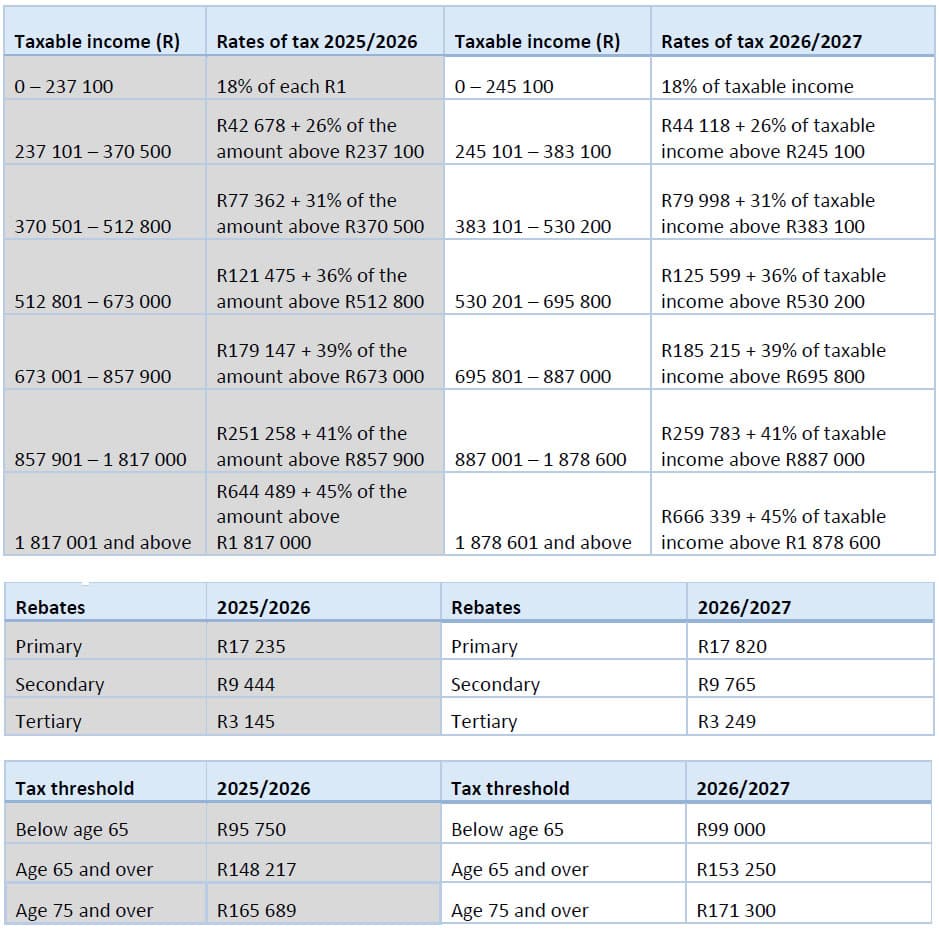
Trusts other than special trusts: Tax rate of 45%
Medical tax credits

Retirement fund lump sum withdrawal benefits (unchanged)

Retirement fund lump sum benefits or severance benefits (unchanged)

Subsistence allowances
From 1 March 2026, the daily deemed expense thresholds for business travel within the Republic that includes at least one overnight stay will be:

For business trips where no overnight stay is required, the daily deemed expense threshold for meals and incidental costs will be R184.
Where the accommodation to which that allowance or advance relates is outside of the Republic, and the allowance or advance is paid or granted to cover the cost of meals and incidental expenses, the applicable amount per day will be determined in accordance with the ‘Table: Daily Amount for Travel Outside the Republic’, under Notice 4458 published in Government Gazette No. 50243, dated 1 March 2024.
Travelling allowance
Rates per kilometre, which may be used in determining the allowable deduction for business travel against an allowance or advance where actual costs are not claimed, are determined using the following table:
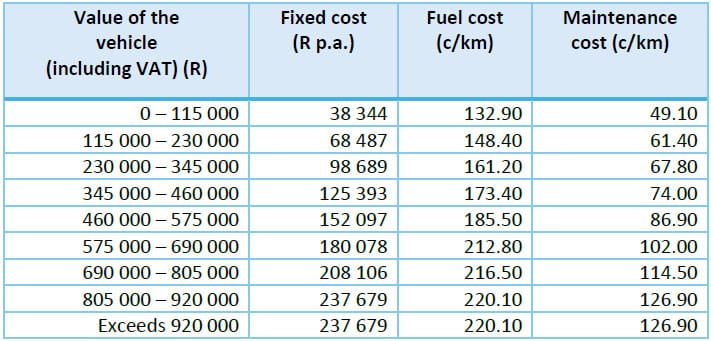
SARS (AA) rate per kilometre
From 1 March 2026, where the reimbursed rate exceeds the prescribed rate of R4.95 per kilometre (previously R4.76), an inclusion in remuneration for PAYE purposes applies, regardless of the business kilometres travelled. The full inclusion amount is subject to PAYE, unlike the fixed travel allowance where only 80% of the amount is subject to PAYE.
However, this alternative is not available if other compensation in the form of an allowance or reimbursement (other than for parking or toll fees) is received from the employer in respect of the vehicle.
To view the official Budget Speech, follow the link.
To view all of the budget documents, follow the link.